


ABSCINT is developing single-domain antibodies for disease diagnosis through imaging.
Brussels, Liège– May 28, 2026 – ABSCINT, a clinical-stage molecular imaging company, today announced compelling clinical results for its novel HER2-targeted imaging agent, 68Ga-ABS011 PET/CT. Designed to enable whole-body, non-invasive assessment of HER2 expression in patients with breast cancer and other solid tumours, the technology aims to improve patient diagnosis, treatment selection, and therapy monitoring.The results include data from 45 patients analyzed in the Phase IIb HERMIA study, within a broader clinical dataset of 120 patients evaluated across completed Phase I and Phase II studies. The data demonstrated strong safety, high diagnostic accuracy, and meaningful clinical impact.
Safe, Practical, and Non-Invasive Imaging
68Ga-ABS011 PET/CT was designed for seamless integration into routine clinical practice, enabling same-day tracer administration and PET/CT imaging. Across clinical studies, the ABSCINT product demonstrated a favorable safety and tolerability profile, with no observed immunogenicity, no drug-related adverse events, and no interference with ongoing HER2-targeted therapies. The tracer showed good biodistribution characteristics, including low background uptake in non-target tissues and rapid renal clearance without metabolite formation. The tracer, combined with the short half-life of only 68 minutes of Gallium-68, makes this technology a safe and efficient diagnostic solution while minimizing radiation exposure to patients.
Revealing HER2 Heterogeneity to Guide Therapy
A key advantage of ABSCINT’s HER2 PET/CT approach is its ability to provide a whole-body assessment of HER2 expression across multiple tumor lesions, revealing clinically relevant intra-patient heterogeneity which conventional biopsies may miss. Variability in HER2 expression across lesions can significantly affect treatment response, yet conventional biopsies capture only a limited part of the disease biology.
In ABSCINT’s clinical study, HER2 PET/CT results prompted treating physicians to modify therapy plans in 34.4% of patients, highlighting the technology’s potential clinical impact even at this stage of evaluation.
Martine J. Piccart, MD, PhD. Oncologist: “Molecular imaging has the potential to transform us into better doctors because we will identify patients for whom giving the drug does not make sense. This also means that we will spare patients who are not going to respond from the toxicity of the drug in terms of side effects, as well as from the financial toxicity to society. On the other hand, we will also identify a group of patients for whom the drug can be truly beneficial.”
High Diagnostic Performance and Dependability
Clinical data demonstrated a 91% overall agreement with standard HER2 diagnostic methods (IHC/ISH) at the lesion level, confirming strong diagnostic performance and reproducibility. However, HER2 PET/CT goes beyond conventional biopsy by providing a non-invasive, whole-body assessment of HER2 expression across all lesions, enabling detection of intra-patient heterogeneity that tissue sampling alone may fail to capture.
Reducing Unnecessary Toxicity Through Better Monitoring
This technology enables early-response monitoring and can be combined with FDG PET imaging to improve the prediction of treatment outcomes and identify non-responders earlier. This allows clinicians to adjust therapies in real time, potentially improving efficacy while reducing toxicity, as well as identifying patients with HER2-positive disease biology that may be underestimated or missed by conventional biopsy-based testing, thereby improving patient selection for targeted therapies.
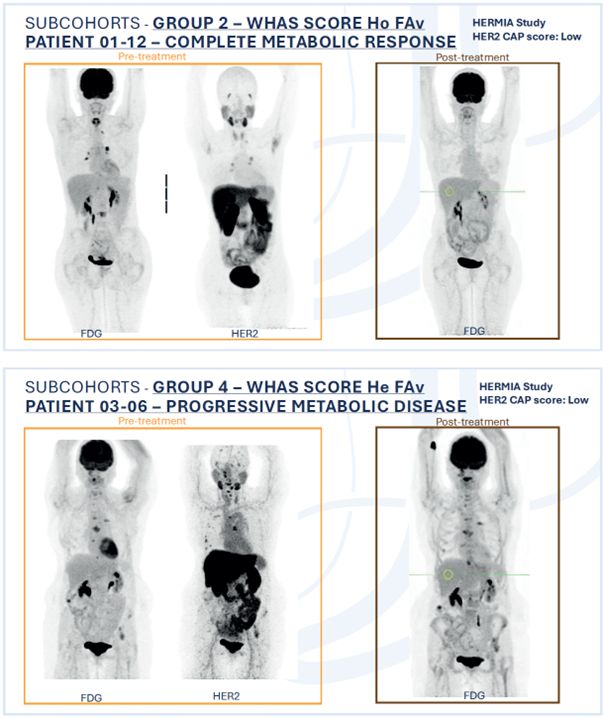
As shown in the images below, patient 01-12 responded well to treatment and displayed homogeneous HER2 expression across lesions, whereas patient 03-06 experienced poor treatment response associated with HER2 expression. Importantly, both patients were classified as HER2-low by standard IHC/ISH analysis, highlighting the inability of conventional biopsybased methods to fully capture HER2 heterogeneity.
ABSCINT is a clinical-stage molecular imaging company and a spin-off from Vrije Universiteit Brussel, focused on developing next-generation diagnostic tools based on radiolabeled single-domain antibodies (sdAbs). The company is committed to advancing precision medicine by overcoming the limitations of conventional diagnostics to enable more accurate, non-invasive assessment of disease biology.
ABSCINT is supported by a broad group of investors, including institutional life science investors: Qbic, Noshaq, Kazoku, and Wallonie Entreprendre (WE), strategic industry players (Trasis), and private investors, united by the view that next-generation diagnostics are essential to unlock the full potential of precision medicine.


